
 返回
返回Study on “Phonon lasing enhanced mass sensor with zeptogram resolution under ambient conditions” was published in Chip
The paper "Phonon lasing enhanced mass sensor with zeptogram resolution under ambient conditions" by PhD student Fei Pan, etc. was successful published in Chip on July 12, 2023 (DOI: 10.1016/j.chip.2023.100050).
Mass spectrometry is a powerful analytical technique which is widely adopted to determine the molecular mass of samples, elemental composition and structural information, making it an indispensable tool in qualitative and quantitative applications including biological research, chemical measurements, astrophysical analysis and environmental monitoring. Mass sensing based on the mechanical oscillators is realized by detecting the mechanical frequency shift when adding the detected particles onto the oscillator. However, due to the large mechanical dissipation in the ambient environment, ultrasensitive mass sensing with zeptogram or higher resolution usually needs a vacuum or cryogenic environment.
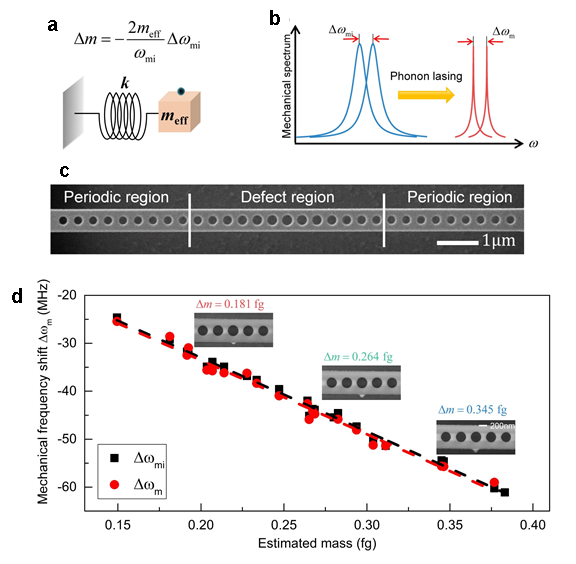
In this work, a new approach that utilizes phonon lasing to achieve an ultra-narrow mechanical linewidth, allowing a predicted maximum mass resolution up to zeptograms at room temperature in an ambient environment. With blue-detuned laser pumping, the mechanical linewidth is narrowed from 2.6 MHz to 5.4 kHz after phonon lasing. In the mass sensing experiment, a small amount of material (silica) is deposited on the side wall of the optomechanical cavity, resulting in the mechanical frequency shift. Therefore, the minimum detectable mass is predicted to be 6.5×10⁻²⁰ g according to the frequency responsivity. This resolution is an order of magnitude higher than other reported approaches under ambient conditions, proposing a possible next-generation on-chip mass sensing scheme.
Fei Pan, Kaiyu Cui,* Yidong Huang,* Ziming Chen, Ning Wu, Guoren Bai, Zhilei Huang, Xue Feng, Fang Liu, and Wei Zhang, Phonon lasing enhanced mass sensor with zeptogram resolution under ambient conditions. Chip 2023, 100050. https://doi.org/10.1016/j.chip.2023.100050
News
Faculty member and student of our lab. Attend CLEO 2026 and Present Research Findings2026-06-01
The 2026 Symposium on Nano-Optoelectronics Marks a Resounding Success2026-05-23
Dr. Kaiyu Cui and Dr. Hao Sun Invited to Present at COINT 20262026-05-19
Ph.D candidate Zhiyao Ma's work about varifocal metalens was published on Advanced Science2026-05-14
Prof. Kaiyu Cui led the team to participate in the Third Applied Physics Conference2026-04-27
A Visit to the Institute of Plasma Physics, CAS Led by Professor Yidong Huang2026-04-25
