
 返回
返回Ph.D. candidate Zhe Li’s work on valley photonic molecular crystals published in PhotoniX Synergy
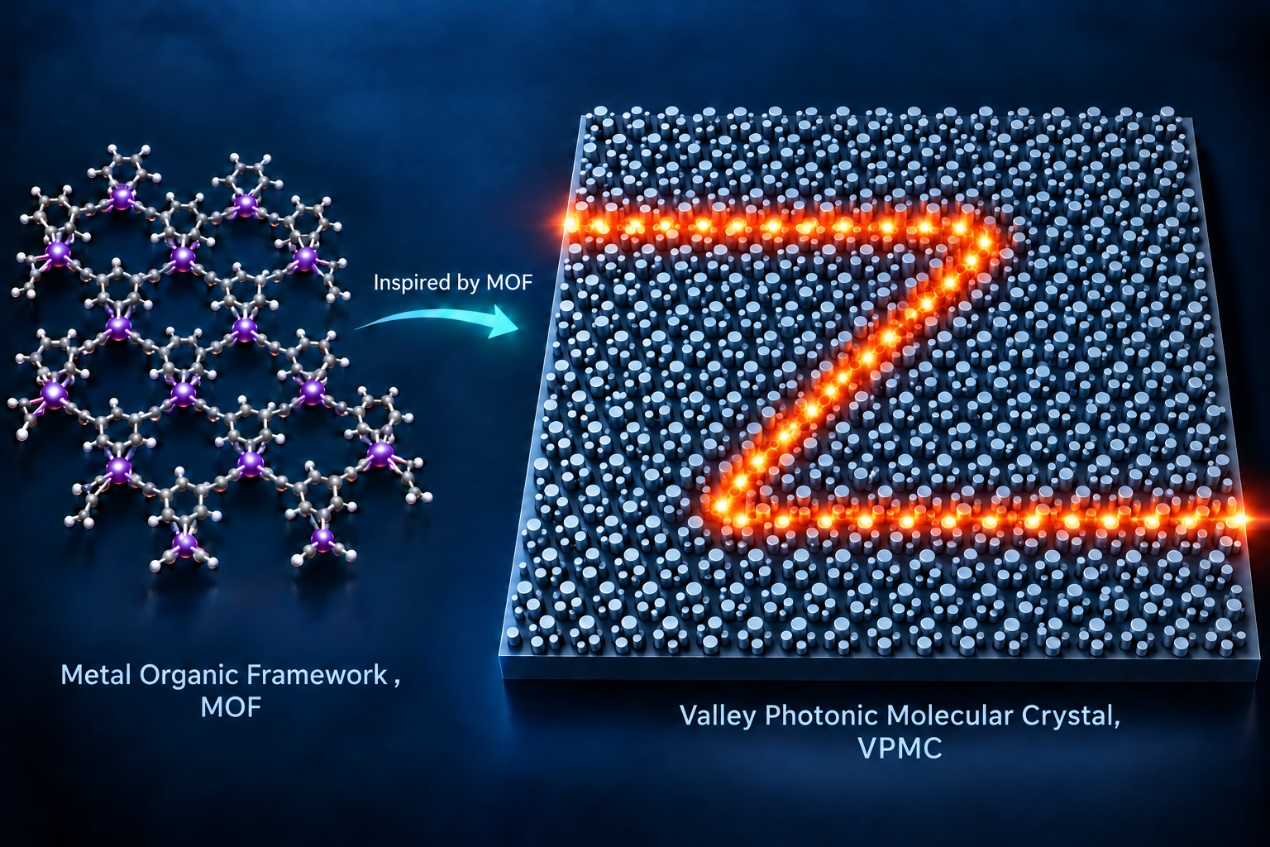
In recent years, topological insulators based on metal-organic frameworks (MoFs) have garnered significant attention due to their structural tunability and potential applications in spintronics, valleytronics, and flexible electronics. These materials consist of periodic structures formed by metal atoms acting as the framework, with organic molecules linked to the metal atoms via coordination bonds. Unlike inorganic crystals, the organic molecules within MOFs possess rotational degrees of freedom, which can significantly influence the material's optical and mechanical properties. However, the impact of molecular rotation on the topological properties of MOF-based topological insulators remains under-explored. This is primarily because random rotation disrupts the system's periodicity, rendering traditional topological characterization methods—which rely on band theory and momentum space—difficult to apply directly.
Photonic crystals, which exhibit band structures and topological properties analogous to those of electronic crystals, serve as ideal platforms for simulating topological phases of matter found in condensed matter physics, particularly given the ease with which their bands and wavefunctions can be manipulated. Inspired by molecular topological insulators, this study introduces rotational degrees of freedom into valley photonic crystals to construct "Valley Photonic Molecular Crystals" (VPMCs), in which the positions of the "molecules" remain periodically arranged while their orientations are randomly distributed. Addressing this rotationally disordered system, the study establishes an effective Hamiltonian model and proposes an effective topological index. By combining these with the real-space Spectral Localizer operator, the research systematically analyzes how the topological properties of VPMCs evolve with the degree of rotational disorder.
The key innovations of this paper are as follows:
1. It establishes a theoretical model describing how rotational degrees of freedom influence valley topological properties in valley photonic molecular crystal systems. Using an effective Hamiltonian approach, the paper derives the valley topological invariant for VPMCs. This invariant enables a simple and efficient assessment of the effective valley Chern number, thereby resolving the challenge of calculating topological invariants in valley photonic molecular crystals.
2. The robustness against rotational disorder and the tunability of the valley photonic molecular crystal system were verified. The study systematically tracked the evolution of valley topological properties as rotational disorder increased, revealing the system's robustness against strong rotational disorder. Furthermore, the competition between valley topological edge states and Anderson localized states under strong rotational disorder was discussed. This work holds the potential to establish molecular rotation as a new degree of freedom for topological control.
This work was published in the journal PhotoniX Synergy on October 1, 2026, under the title "Valley Photonic Molecular Crystals." PhD candidate Zhe Li is the first author, and Associate Professor Xue Feng is the corresponding author. (Paper link: https://doi.org/10.1007/s44519-026-00017-3)
News
Faculty member and student of our lab. Attend CLEO 2026 and Present Research Findings2026-06-01
The 2026 Symposium on Nano-Optoelectronics Marks a Resounding Success2026-05-23
Dr. Kaiyu Cui and Dr. Hao Sun Invited to Present at COINT 20262026-05-19
Ph.D candidate Zhiyao Ma's work about varifocal metalens was published on Advanced Science2026-05-14
Prof. Kaiyu Cui led the team to participate in the Third Applied Physics Conference2026-04-27
