
 返回
返回Ph.D. Student Tianhao Liu ’s work on Integrated Spectral in-Sensor Computing Diagnosis of Meibomian Gland Dysfunction Published in PhotoniX
In modern high-intensity visual environments, dry eye disease has become one of the most common ocular surface disorders, affecting over 340 million people worldwide. Among these cases, approximately 70% are of the evaporative type, with meibomian gland dysfunction (MGD) being the primary cause. Traditional diagnostic methods for MGD rely on subjective assessment or morphological imaging, which struggle to achieve accurate and early detection at the tissue composition level. Spectral imaging, which captures the "fingerprint information" of substances, offers a new technological pathway for revealing changes in tissue composition.
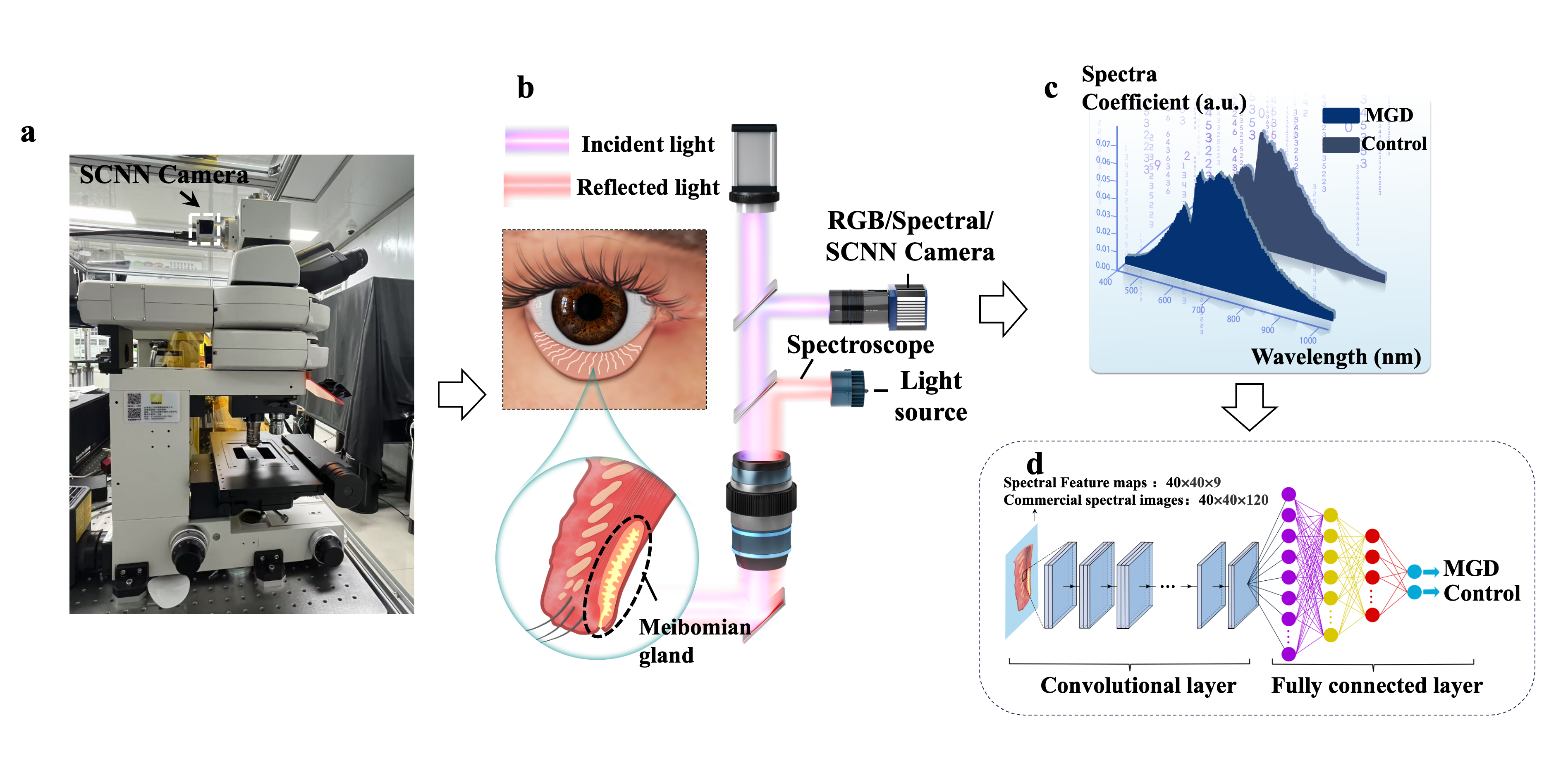
In this work, based on a metasurface spectral convolutional neural network (SCNN) chip, a novel diagnostic approach for MGD is proposed. The chip deeply integrates metasurface optical modulation with a CMOS image sensor, enabling the acquisition of spectral information and feature extraction within a single exposure in tens of milliseconds, without mechanical scanning, thereby achieving “in-sensor computing.” Experimental results demonstrate that this method can capture MGD-related variations in hemoglobin and lipid components within the key wavelength range of 500–900 nm, achieving a diagnostic accuracy of 96.22%, which significantly outperforms conventional RGB imaging methods.
This study not only reveals the tissue compositional characteristics of MGD from the perspective of “spectral pathology” for the first time, but also reconstructs the diagnostic workflow from “acquisition followed by computation” to an integrated “in-sensor computing” paradigm. While maintaining high accuracy, it significantly improves the speed of information acquisition and processing. The results provide important technical support for non-invasive, real-time, and precise diagnosis of ocular surface diseases such as dry eye, and highlight the broad potential of integrating photonic chips with medical diagnostics.
This work was carried out by Associate Professor Kaiyu Cui’s research group in collaboration with the Department of Ophthalmology at Peking Union Medical College Hospital. The paper, “Diagnosis of Meibomian Gland Dysfunction Based on Spectral Convolutional Neural Network Chip,” was published online in PhotoniX on April 20, 2026. PhD student Tianhao Liu and postdoctoral researcher Yue Shi are co-first authors,while Associate Professor Kaiyu Cui and Associate Professor Di Chen from the ophthalmology department are co-corresponding authors.
News
Faculty member and student of our lab. Attend CLEO 2026 and Present Research Findings2026-06-01
The 2026 Symposium on Nano-Optoelectronics Marks a Resounding Success2026-05-23
Dr. Kaiyu Cui and Dr. Hao Sun Invited to Present at COINT 20262026-05-19
Ph.D candidate Zhiyao Ma's work about varifocal metalens was published on Advanced Science2026-05-14
Prof. Kaiyu Cui led the team to participate in the Third Applied Physics Conference2026-04-27
A Visit to the Institute of Plasma Physics, CAS Led by Professor Yidong Huang2026-04-25
