
 返回
返回Ph.D. Student Ziyue Yang’s work on SUANPAN: Scalable Photonic Linear Vector Machine published in Light: Science & Applications
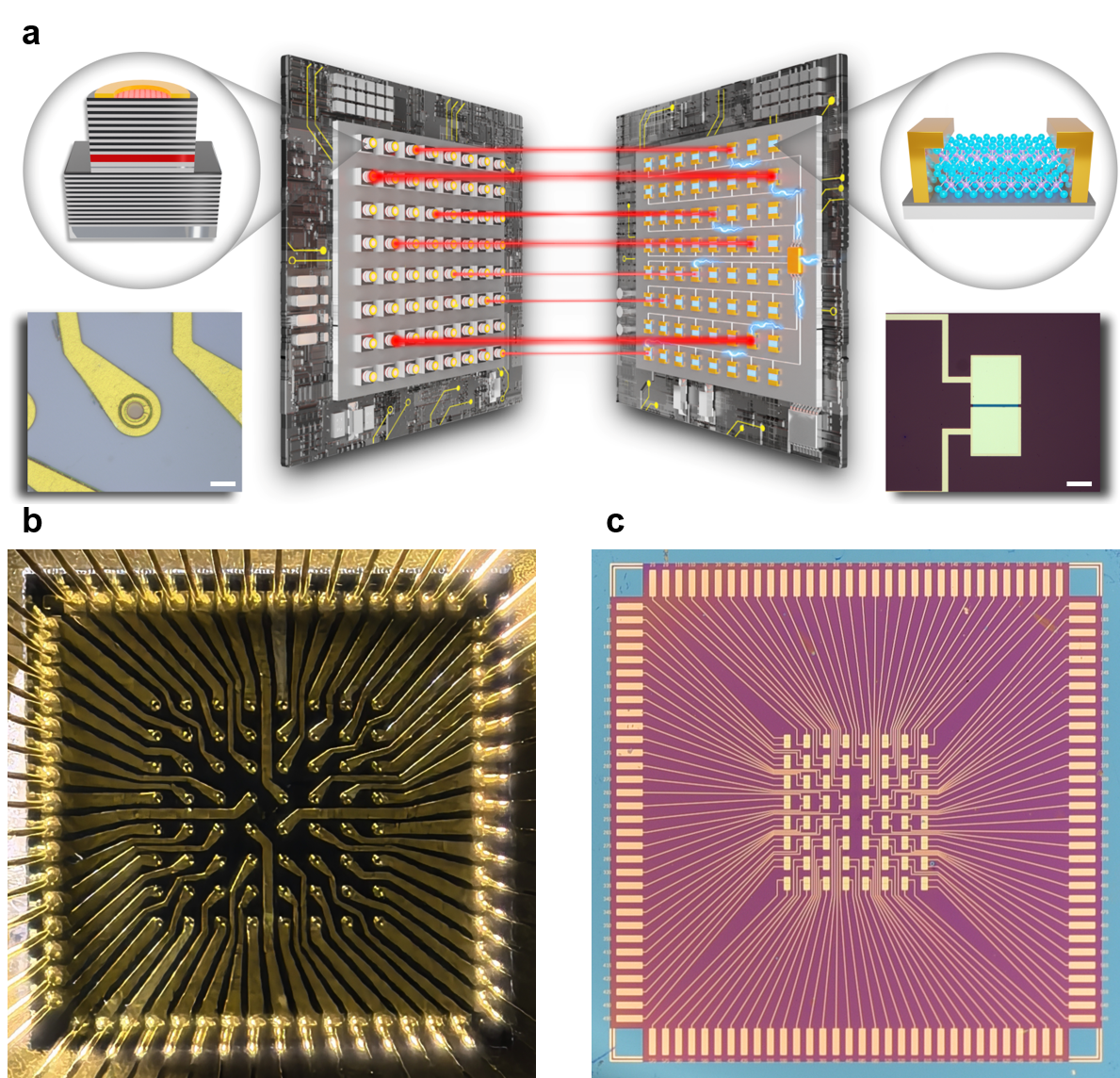
Photonics is promising to handle extensive vector multiplications in artificial intelligence techniques due to natural bosonic parallelism and high-speed information transmission. However, the dimensionality of current photonic linear operation is limited and tough to improve due to the complex beam interaction for implementing optical matrix operation and digital-analog conversions. Here, we propose a programmable and reconfigurable photonic linear vector machine with extreme scalability formed by a series of emitter-detector pairs as the independent basic computing units. The elemental values of two high-dimensional vectors are prepared on emitter-detector pairs by bit encoding and analog detecting method without requiring large-scale ADC or DAC arrays. Since there is no interaction among light beams inside, extreme scalability could be achieved by simply multiplicating the independent emitter-detector pair. The proposed architecture is inspired by the traditional Chinese Suanpan, and thus, is denoted as photonic SUANPAN. Experimentally, the computing fidelities for random vector inner products could achieve >98% in our implementation with an 8×8 vertical cavity surface emission laser (VCSEL) array and an 8×8 MoTe2 two-dimensional material photodetector array. Furthermore, a competitive classification accuracy of 88% is achieved for ANN on MNIST handwritten digit dataset, and a randomly generated 1024-dimensional Ising problem is successfully solved, which is the highest dimensionality of optical Ising machine with heuristic algorithm. We believe that our proposed photonic SUANPAN is capable to serve as a fundamental linear vector machine and is potential to enhance the computing power for future various AI applications.
This work was published on Jan.1st 2026 in Light: Science & Applications. Ph.D. student Ziyue Yang and Chen Li are the first authors of this paper. Prof. Xue Feng, Prof. Yongzhuo Li and Prof. Yidong Huang are the corresponding authors. The collaborative institutions also include Peking University, Berxel Photonics Company, and Shenzhen Technology University.
The link of article: https://doi.org/10.1038/s41377-025-02059-7
News
Faculty member and student of our lab. Attend CLEO 2026 and Present Research Findings2026-06-01
The 2026 Symposium on Nano-Optoelectronics Marks a Resounding Success2026-05-23
Dr. Kaiyu Cui and Dr. Hao Sun Invited to Present at COINT 20262026-05-19
Ph.D candidate Zhiyao Ma's work about varifocal metalens was published on Advanced Science2026-05-14
Prof. Kaiyu Cui led the team to participate in the Third Applied Physics Conference2026-04-27
A Visit to the Institute of Plasma Physics, CAS Led by Professor Yidong Huang2026-04-25
