
 返回
返回PhD Student Shurui Huang's research on Optimizing Electrodes for Ultra-high-speed Electro-optic Modulators was published on IEEE Photonics Journal
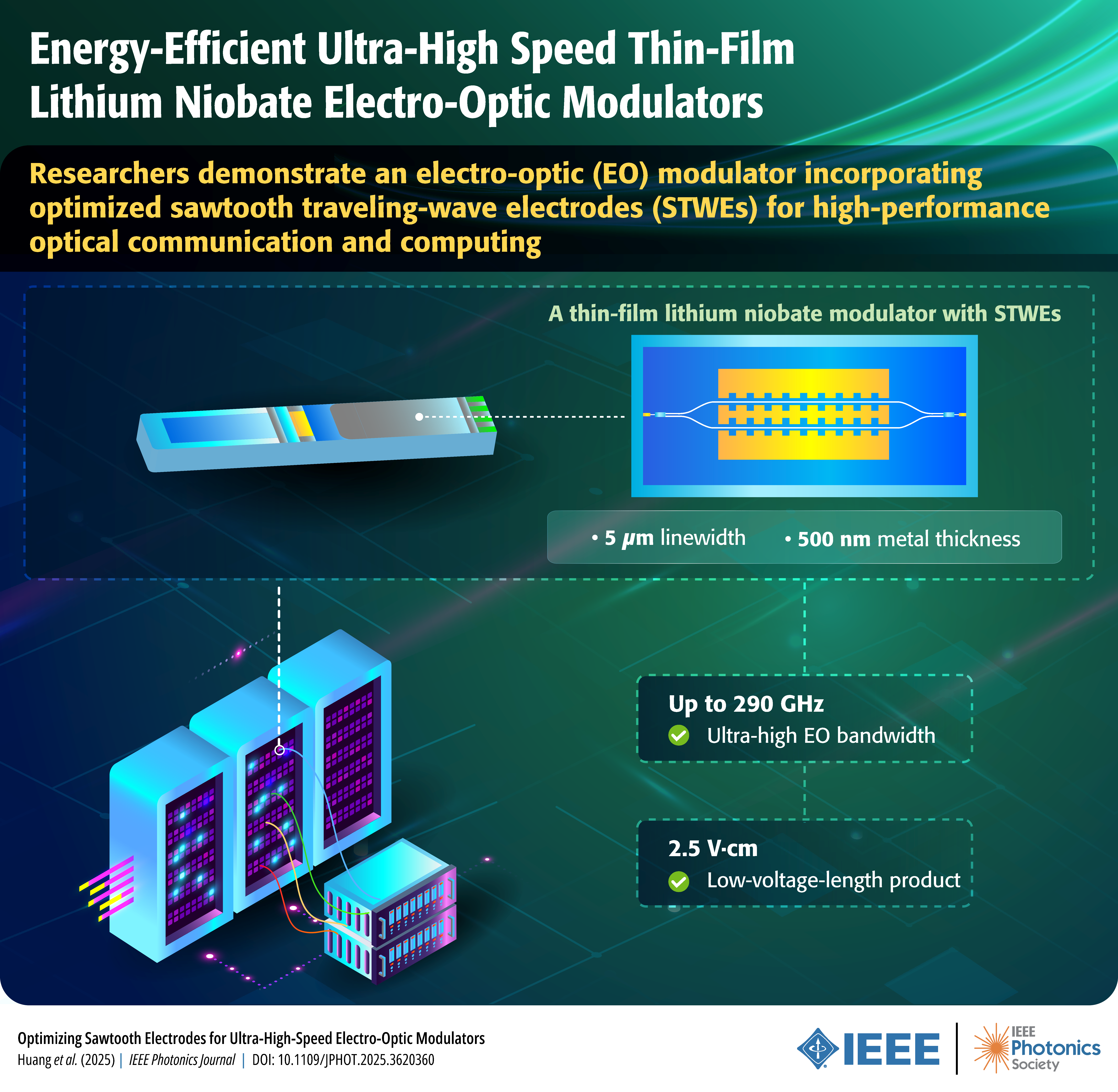
As a core component for enabling high-speed optical interconnects, optical computing, and broadband microwave photonic links, the performance of electro-optic modulators directly determines the bandwidth and energy efficiency of information systems. Currently, one of the key challenges in the promising silicon-based thin-film lithium niobate (TFLN) integrated photonic platform is achieving both ultra-high modulation bandwidth and low drive voltage. Traditional electrode designs often struggle to balance bandwidth and voltage, and high-performance structures depend on costly electron-beam lithography, limiting large-scale, low-cost manufacturing and application. The team at Tsinghua University has proposed an innovative solution to this core issue with the optimization method for the sawtooth traveling wave electrodes (STWEs).
Based on the transmission line RGLC equivalent circuit model, the study establishes, for the first time, analytical expressions for the key geometric parameters (such as slot depth and width) of sawtooth electrodes and their microwave characteristics (resistance, inductance, capacitance, and conductance). The structure’s application in TFLN electro-optic modulators was validated through simulations. The optimized electrode achieved a high electro-optic bandwidth of 290 GHz and a low half-wave voltage-length product (Vπ·L) of 2.5 V·cm on a silicon-based TFLN modulator, significantly improving modulator efficiency and reducing the required drive voltage. The optimized electrode features a minimum line width of 5 μm and a metal thickness of only 500 nm, compatible with deep ultraviolet lithography technology, providing advantages for large-scale, low-cost manufacturing. This work not only demonstrates a high-performance electrode design example but also proposes a universal optimization framework applicable to any periodic electrode structure. It provides a powerful design tool and device foundation for future electro-optic modulators in advanced applications such as terahertz communication and energy-efficient optical computing.
This work was completed by Assoc. Prof. Xue Feng’s team, and the paper "Optimizing Sawtooth Electrodes for Ultra-high-speed Electro-optic Modulators" was officially accepted by IEEE Photonics Journal on December 9. Assoc. Res. Yongzhuo Li, Assoc. Prof. Xue Feng, and Prof. Yidong Huang are co-corresponding authors, with PhD student Shurui Huang as the first author. The research was supported by the National Key Research and Development Program and the National Natural Science Foundation of China.
News
Faculty member and student of our lab. Attend CLEO 2026 and Present Research Findings2026-06-01
The 2026 Symposium on Nano-Optoelectronics Marks a Resounding Success2026-05-23
Dr. Kaiyu Cui and Dr. Hao Sun Invited to Present at COINT 20262026-05-19
Ph.D candidate Zhiyao Ma's work about varifocal metalens was published on Advanced Science2026-05-14
Prof. Kaiyu Cui led the team to participate in the Third Applied Physics Conference2026-04-27
A Visit to the Institute of Plasma Physics, CAS Led by Professor Yidong Huang2026-04-25
